
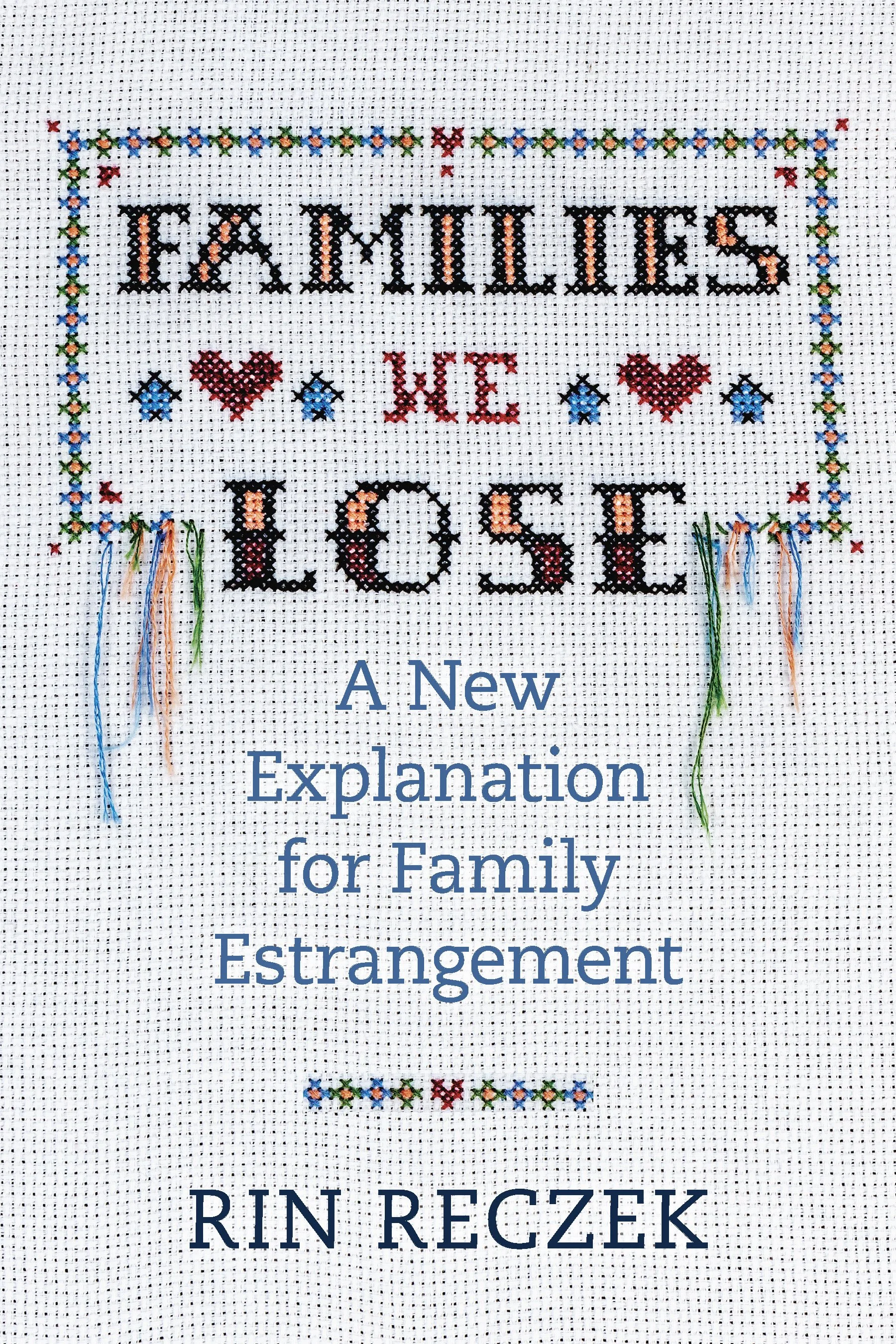
The Families We Lose Book
Families We Lose:
A New Explanation for Family Estrangement
For sale now on Amazon and Barnes and Noble
As society becomes more polarized around political and cultural beliefs, family estrangement has received increased attention. Going no contact with a parent, sibling, grandparent, or other extended family members is often portrayed as a sign of the further fraying of society, sometimes even as a result of selfish choices that privilege the rights of the individual over the ability to compromise. In Families We Lose Rin Reczek takes a different view, arguing that going no contact isn’t done on a whim by selfish people, or due only to specific individual circumstances. Instead, she argues that contemporary family estrangement is indicative of a more fundamental culture clash in the very meaning and expectations of family in the US today. Reczek shows that estrangement is sparked by a confrontation between the traditional culture—which demands the family of origin is unconditionally forever—and a rivaling idea of family that values the quality of contact, focusing on equity, accountability, personal and relationship evolution, mutual respect, and maturity. At stake in the clash between compulsory and democratized kinship is a battle to determine the very meaning of “family” in the US today.
Based on in-depth interviews with a diverse set of adults who are ‘no-contact' with one or more family-of-origin member, Reczek reveals how these adults set new expectations about family. She shows that estrangement can be a path to healing, self-acceptance, and democratized configurations of family around the shared values of mutuality and intentional community. Shifting the focus from family reunification to family freedom, Families We Lose imagines a world where adults are empowered to choose who gets to be in their family – even if it means leaving some ties behind.
Reviews of Families We Lose
-
Families We Lose
Following her landmark study of family bonding, sociologist Rin Reczek takes on the growing trend of family estrangement in Families We Lose, a sobering but illuminating investigation into a misunderstood phenomenon of American family life.
Drawing on recent fieldwork, the book presents a subtle counterweight to prevailing panic around the growing number of adults choosing to go no-contact with their biological families. Rather than representing a widespread breakdown of social order, the book says, the prevalence of family estrangement represents a much simpler and less threatening reality: Estrangement happens, it argues, when family members have fundamental differences in their definitions of family itself.
The concept of “compulsory kinship,” or the idea that biological ties bind families together on a permanent basis, is indicted with creating friction. An alternative model, “democratized kinship,” in which family members are treated as equals and must make active efforts to meet certain thresholds of respect, is introduced. The book’s narratives showcase the friction between the two models, tracing a diverse range of modern relationships broken apart by fundamental gaps in understanding.
Indeed, the book’s response to the trend of family estrangement is elegant and objective. Its range of perspectives from interviewees who went no-contact gives the book just enough runway to explore the impacts of abuse, gender dynamics, sexual identities, and immigrant experiences while staying cohesive to its original claim. However, the tender characterization of interviewees who estranged their family members creates a sympathetic tone that ends up obscuring, or overwriting, the experiences of family members on the other side of the equation. While the book’s diagnosis is graceful, its enthusiasm for “built families” over biological families is underexplored, as is the potential severity of estrangement.
Families We Lose is an academic but accessible study of family estrangement built on a wide array of testimonies.
Reviewed by Isaac Randel
July / August 2026Disclosure: This article is not an endorsement, but a review. The publisher of this book provided free copies of the book to have their book reviewed by a professional reviewer. No fee was paid by the publisher for this review. Foreword Reviews only recommends books that we love. Foreword Magazine, Inc. is disclosing this in accordance with the Federal Trade Commission’s 16 CFR, Part 255.
-
"Stories about family estrangement are proliferating, but most of these are told by the parents and grandparents who get left behind. With Families We Lose, finally we hear from those who are doing the leaving. Best of all, this important book helps to demystify the phenomenon, beyond too-simple explanations of unhappy people lured to estrange from others by therapy or social media. Instead, Rin Reczek points out that what we are seeing is a collision of two cultural ideals of what counts as family, and what we ought to expect from family members. With poignant accounts from people who insist upon a new model of democratized kinship, Reczek counters popular concern about why those who estrange themselves “don’t value family.” Instead, as this book demonstrates, they value family so much, they are willing to invent new relationships to pursue a better version of it. Families We Lose goes beyond the headlines to add some important voices missing from the current conversation, and to give us some vital analytical tools to make sense of them."
-
"Reczek's clearly written and accessible book does what the best sociology does: takes things that we think of as individual or interpersonal and reveals to us their social and cultural causes. In this timely work, Reczek counters panicky public discourse about family estrangement as a trendy moral failing of 'kids these days' and instead asks us to consider how different ideologies of family clash to produce the phenomenon of estrangement. Rooted in people's first-hand experiences, this book sheds much-needed sociological light into the so-called private world of family trauma, disagreement, and grief, as well as belonging and joy. A must-read for scholars of family, culture, gender and sexuality, intersectionality, and interpersonal violence."
-
"This book is a major contribution to the study of family, culture, gender, sexuality, and social change. Reczek offers an important new way of understanding the democratization of intimacy. Reczek's work on family estrangement is path-breaking."
-